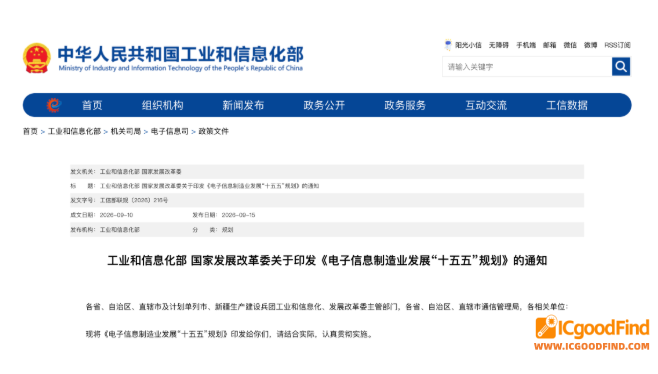
China's Ministry of Industry and Information Technology (MIIT) and the National Development and Reform Commission (NDRC) have jointly issued the 15th Five‑Year Plan for the Electronics and Information Manufacturing Industry (2026–2030) – a top‑level roadmap for the sector.
Key targets by 2030:
Revenue of industrial enterprises above designated size to exceed RMB 30 trillion
R&D intensity to reach 3.5%
Build globally competitive leaders across integrated circuits, advanced computing, consumer electronics, basic electronics, and energy electronics
The plan sets 17 key tasks and 9 special initiatives across four pillars: laying the foundation, improving quality, cultivating new growth, and governance.
IC and foundational tech: Full‑chain IC technology breakthroughs, high‑performance processors, high‑density memory, high‑reliability analog/mixed‑signal chips; optimization of mature nodes and continued advancement of leading‑edge processes. Accelerate wide‑bandgap semiconductors, including gallium oxide and diamond ultra‑wide‑bandgap commercialization. Boost sensors, electronic materials, equipment, and photonics.
Advanced computing: Build a domestic advanced computing ecosystem, deploy storage‑in‑memory, quantum, optical, brain‑inspired, and space computing architectures, and support hundreds‑of‑thousands‑card AI clusters. Consumer electronics upgrades for phones, PCs, VR/AR, and wearables; promote OpenHarmony and RISC‑V development.
New growth areas: Energy electronics (perovskite tandem cells, solid‑state, sodium‑ion, flow batteries), spatiotemporal information (BeiDou expansion, satellite internet, direct‑to‑cell satellite terminals), and AI hardware (cloud training chips, edge inference chips, on‑device LLMs and agents). Target scenarios include smart cities, autonomous driving, low‑altitude economy, commercial space, and deep‑sea/polar applications.
Sustainability and governance: Build patent pools in ICs, BeiDou, PV, and new batteries; monitor capacity and prevent disorderly competition; establish carbon footprint standards and recycling rules for lithium batteries and PV modules; optimize regional industrial layouts and create world‑class manufacturing clusters.
MIIT noted that during the 14th Five‑Year Plan, electronics manufacturing revenue ranked first among all industrial sectors for 13 consecutive years, with breakthroughs in ICs, servers, and displays. The 15th FYP aims to strengthen competitiveness while safeguarding supply chain security.
ICgoodFind Takeaway:
The 15th FYP puts ICs, advanced computing, and semiconductor materials/equipment at the center of China's industrial policy. For buyers, this signals long‑term support for domestic chip and component localization – track supply chain progress closely.
